
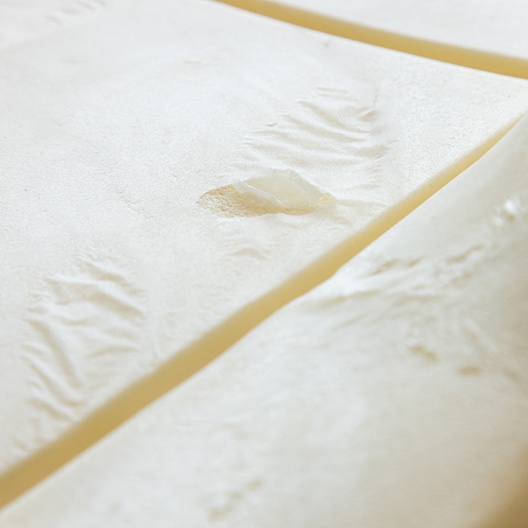
Skinning of polyurethane foam cushion
Description:
In the present problem, the outer layer of the skin is detached from the underlying structure.
Affected Foam Parts:
Affected are parts made of soft foam, high resilient foam, viscoelastic foam for automotive or furniture industry (headrests, armrests and cushions, as well as pillows and mattresses), acoustic foam, insulation foam and back foam.
What causes it:
Skin peeling in PU seat cushions is often caused by poor ventilation, the wrong mould temperature or insufficient mixing of the components in the PU foam system. But it can be also caused by the use of an incorrect release agent.
- Bad ventilation/pressure relief void
- Improper mould temperature
- Not properly mixed PU-foam system
- Improper release agent
Solutions:
To prevent skin peeling check the ventilation slots, the mould temperature and other process parameters. Optimize release agent application or change the type of release agent is an alternative solution.
- Check the mould ventilation
- Check the mould temperature
- Check PU processing parameters
- Adjust spray parameters of release agent
- Change release agent
RELATED CASE STUDIES
Chem‑Trend develops, produces and distributes complex, explanation-intensive chemical products and addresses exclusively commercial customers (B2B). This website is intended solely for information purposes for professionally experienced readers in a B2B context and is not intended for consumers. The information contained herein is based on Chem‑Trend’s general experience and knowledge at the time of publication and does not constitute binding specifications, guarantees or warranties. Website information and documents contained herein are confidential and shall not be disclosed, reproduced or forwarded to any third party without the prior explicit written approval of Chem‑Trend.
© 2026 Chem‑Trend L.P. or Chem‑Trend affiliated company. All rights reserved.
- Terms & Conditions
- Privacy Policy
- Cookie Policy
- California Supply Chain Act
- Canada Forced Labor Report
- Compliance/Whistleblowing

Regional websites:
-
 Argentina
-
 Brasil
(Brazil)
Brasil
(Brazil) -
 Canada
-
 Česko
(Czech Republic)
Česko
(Czech Republic) -
 CIS (excluding Russia)
-
 Deutschland
(Germany)
Deutschland
(Germany) -
 España
(Spain)
España
(Spain) -
 France
-
 India
India
-
 Italia
(Italy)
Italia
(Italy) -
 México
-
 România
(Romania)
România
(Romania) -
 Polska
(Poland)
Polska
(Poland) -
 Türkiye
(Turkey)
Türkiye
(Turkey) -
 United Kingdom
-
 United States
-
 Việt Nam
(Vietnam)
Việt Nam
(Vietnam) -
 中国
(China)
中国
(China) -
 한국
(South Korea)
한국
(South Korea) -
 日本
(Japan)
日本
(Japan)
Notice
You are about to exit this page. You will be redirected to the Chem‑Trend Global website where you’ll find your requested content in English.
Continue